
Park Pioneer
"He asked me if I could spade. I said yes."

Some pioneers set out to smash boundaries. Others break through simply because they’re following their heart’s demands. I have a feeling Sydney Stein Rich belongs in the latter category. In honor of Women’s History Month, let me tell you about her.
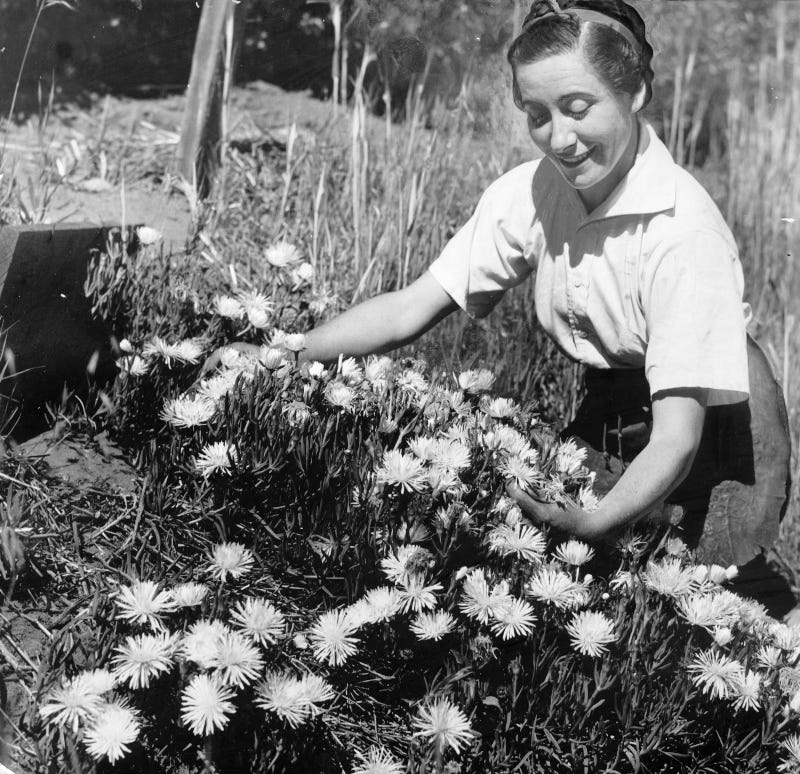
Rich was the first woman gardener in Golden Gate Park, hired by John McLaren in 1929. And like many people who become “firsts,” she was a creature of her own creation.
She was born Sadie Friedman in Brooklyn in 1906 to Jewish Russian immigrants. The family moved to California between 1907 and 1915. Her parents divorced some time after. She left home at 16 and lived on and off for the next seven years at the Emanu-El Residence Club, which offered room and board to young Jewish women. (That same building at 300 Page Street is now home to the San Francisco Zen center.) At some point, she shed her given identity, adopting a new first name, Sydney, and a shortened version of her stepfather’s surname of Wasserstein.
“Get-your-hands-dirty gardening”
One of the club’s patrons, Matilda Esberg, became interested in Stein. Stein told her she wanted to work outdoors. She had spent several months working on a large estate, filling in for a friend who was a gardener there. She found she loved what she later called “plain get-your-hands-dirty gardening.” She much preferred it to sales or stocking shelves as she’d done in her previous jobs.
Esberg sponsored Stein for a spot at the newly established California School of Gardening for Women in Hayward, the state’s first horticultural training program for women. The school was created to help usher women into what then was considered a man’s profession. Stein graduated in 1927— the school’s first graduate — “without ceremony other than eight hours’ hard work in the garden,” the Chronicle reported.
With her degree in hand, Stein returned to San Francisco and asked Golden Gate Park superintendent John McLaren for job. “Didn’t get it right away, but I kept going back,” she recalled in a 1934 profile by The Chronicle. “Finally, he asked me if I could spade. I said yes. So they put me to work spading and I spaded for a year. I’ve been here five years now and I’m still crazy about it.”
She was the only woman among the park’s 100 gardeners. She was also the first to join the Laborers Union, which represented them. (And, I’m willing to bet, she was also one of few Jews working in the park.)
The writer of the profile—herself a woman—marveled at the contradiction posed by “Miss Stein”: “A small, attractive and feminine-looking girl who can and does, talk about manicures and dancing in the same breath as weeds and snails.” For Stein there was no contradiction, (though she admitted she wished she’d taken better care of her hands.) “It’s hard work but women have the artistic talent, the creative ability, the choice of color necessary to make a good landscape artist.”
Or as she told The Examiner years later, “I’ve always thought that gardening … was a most natural career for a woman. Growing things, Watching over their ‘feedings’. Seeing to it that that their environment is right.”
If she faced resentment from her male colleagues, she never complained publicly. But she was also careful not to make waves. “I work hard and never do anything they dislike. I’d just love to wear shorts when I’m working, but they’d never like that. They treat me like a sister,” she told The Chronicle writer. “They’re just grand to work with.”
She was clearly good at her job, winning respect and promotions. By 1934, she’d gained the plum assignment of designing one of the park’s most prominent spots: the flower beds in front of the Conservatory that welcomed visitors and announced events. She was also coaching the male park laborers for the civil service exam to become gardeners.
In 1940 she was promoted to Head Nurseryman. (Gender-neutral titles were decades away.) It was up to her to keep the gardens going through the scarcities of wartime. “She shrewdly purchased a three-year supply of cyclamen seeds from Switzerland realizing the escalation of World War II would soon shut off supply,” according to an essay in Outside Lands. That foresight allowed her to put on a lush display of 900 cyclamen two years later when few of the plants were to be found anywhere else.
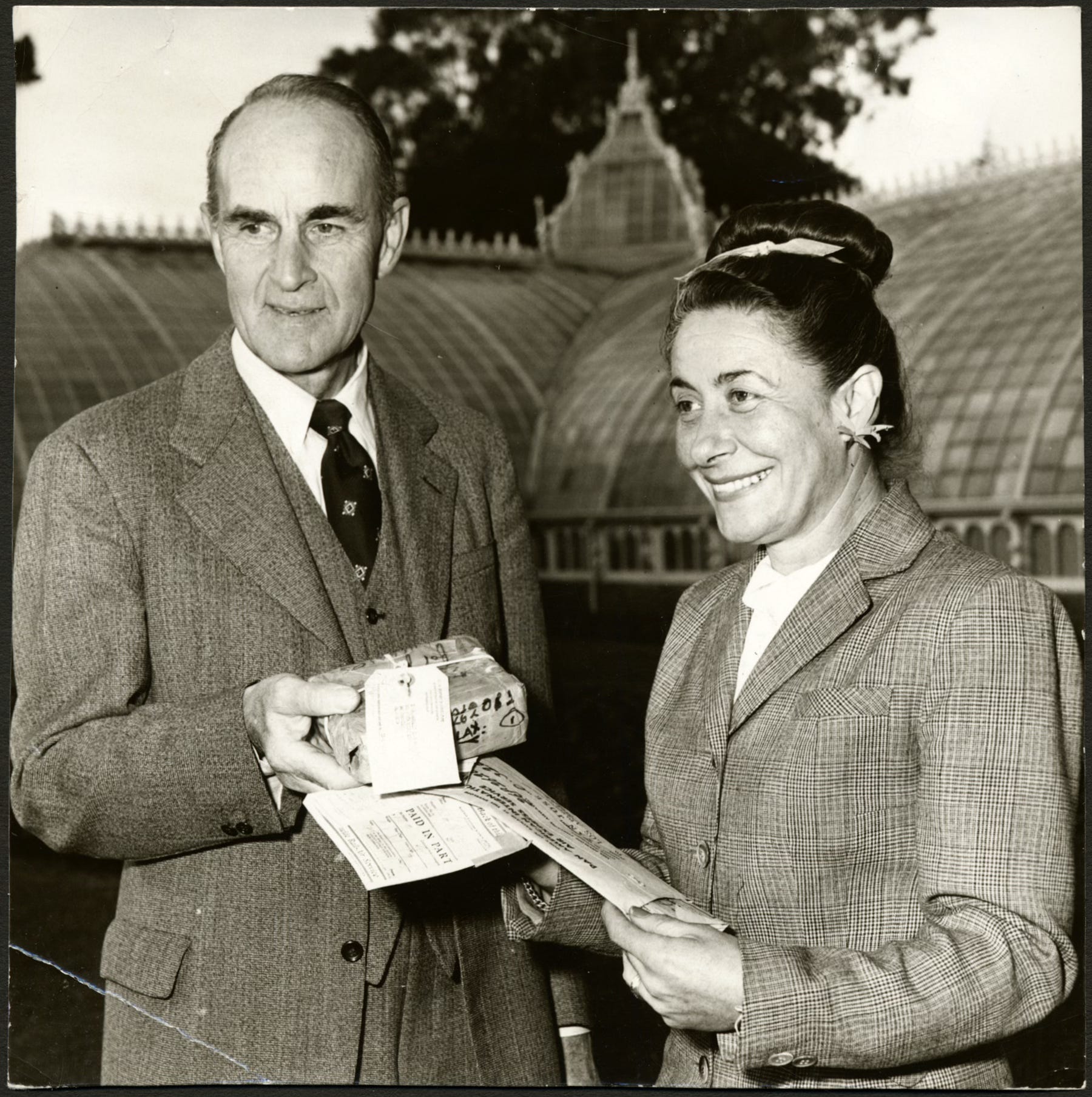
In 1942, she was promoted again, this time to be Superintendent of the Conservatory of Flowers. It was a demanding, highly visible job in which she oversaw care of the collection, acquired new specimens and put on seven flower shows a year. Each show was a feat of precise calculations of growing times and temperatures to ensure that the thousands of cyclamen or begonias or Easter lilies bloomed on cue. If the glowing news reports were any indication, she was a master of the art.
A growing sisterhood
World War Two opened more opportunities for women to work in the park. Some number— I don’t know how many — won temporary jobs to replace the men fighting overseas. These women gardeners “held together” the park, one of their male co-workers told The Chronicle in 1951.
Yet when the war ended, their efforts were no longer welcome, as was true across the country in the post-war push to get women back into the home. A civil service ruling had decreed that the city’s gardening jobs were strictly for men.
Still, five who had been working as temporary gardeners were allowed to take the civil service exam – the only time women were given that chance. They got the highest scores in their class. The city had to give them permanent positions. The Chronicle dubbed them the “Green Thumb Sisterhood.”
That sisterhood remained small for decades. Rec and Park leaders wouldn't consider taking on female gardeners in anything but temporary positions. Women weren’t even allowed to take the civil service exam. One former gardener, Joan Vellutini, recalled being a horticultural student at City College when a high-ranking park official came to speak in 1973. He declared “there was no room for women gardeners in the 1,017-acre park,” she told SFGate. She was devastated.
A class action lawsuit in the late 1970s finally busted down the doors, opening the way for women like Vellutini who wanted to work as gardeners. Five won permanent jobs in 1980. Today, nine of the 42 gardeners in Golden Gate Park are women. (Note: Those bare numbers mask the progress women have made because the park’s workforce has shrunk dramatically in the last 40 years.)
Stein herself resigned from the Conservatory in 1949. She became a flower arrangement consultant for Podesta Boldocchi florists. By then, she had married a widower named Neville Rich. They lived in a small house in Cow Hollow with a small old-fashioned English garden, according to one last profile in The Examiner. Sadly, she died in 1956 of “malignant hypertension,” a sudden and lethal spike in blood pressure. She was only 50.
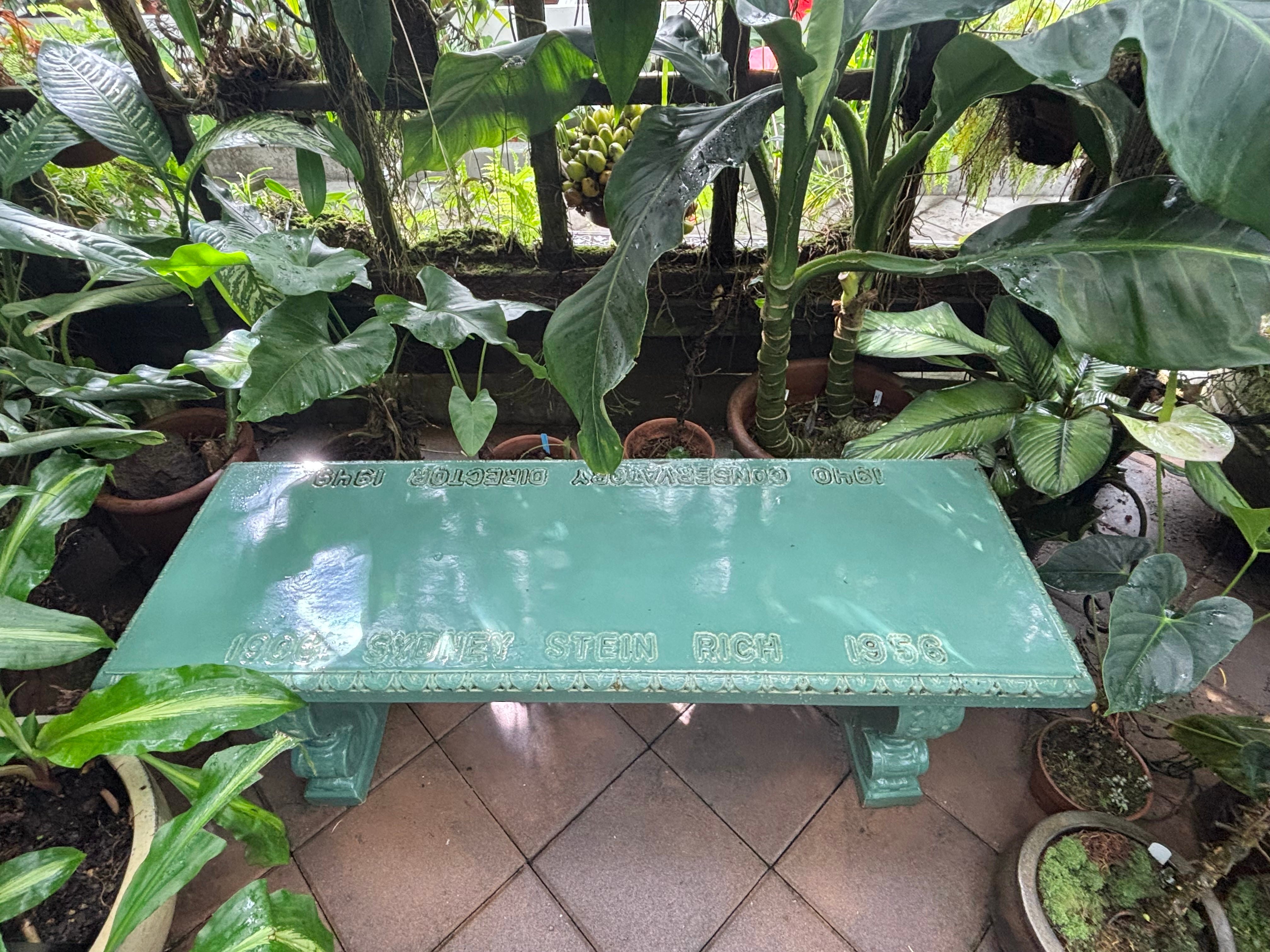
With Stein’s death, her impressive story soon faded from public memory. But in the 1970s, her younger sister worked with Conservatory staff to bring it back by creating a memorial to her sister. In 1983, a beautiful turquoise ceramic bench was installed on a raised platform overlooking Conservatory Valley.
Its significance too was lost over time.
In 2001, as Conservatory staff were preparing for renovation and repair of the building, they came across the bench and puzzled over it. “Who” they asked, “was Sydney Stein Rich?”
That question ended up with horticultural historian Judith Taylor who began excavating Stein’s history. She published Stein’s story in Western State’s Jewish History in 2002. A later version was published in 2014 in Eden: Journal of the California Garden & Landscape History Society.
The bench now sits in the Conservatory’s Potted Plant room in a sweet leafy nook. It feels like a fitting tribute: unobtrusive, yet shining bright, sturdy and surrounded by plants. If there’s an afterlife, I imagine Sydney Stein Rich is happily spending it here.
++
For a fuller story, I urge you to read Taylor’s article, which has informed every subsequent writing about Sydney Stein Rich, including this piece. Another version of her article can be found here. Nicole Medahl, executive director of the Western Neighborhoods Project also has done a lot to publicize Stein’s story, including her essay in Outside Lands mentioned above. She also did a great Zoom talk for SFHeritage in 2020.
I love this piece. So many interesting details contributed to a rich depiction of who she was.
Super interesting. Her spark and her tenacity - her love of gardening - was well felt. Loved it.